Entry 11 / Gods & goddesses
Set
Disruption, strength and an unexpected defender.
Set, also called Seth, was associated with the desert, storms and disruptive force. He is the opponent of Osiris and Horus in important myths, yet he could also defend Ra against the serpent that threatened the sun’s journey. His role cannot be reduced to a simple embodiment of evil.
Take a closer look ↓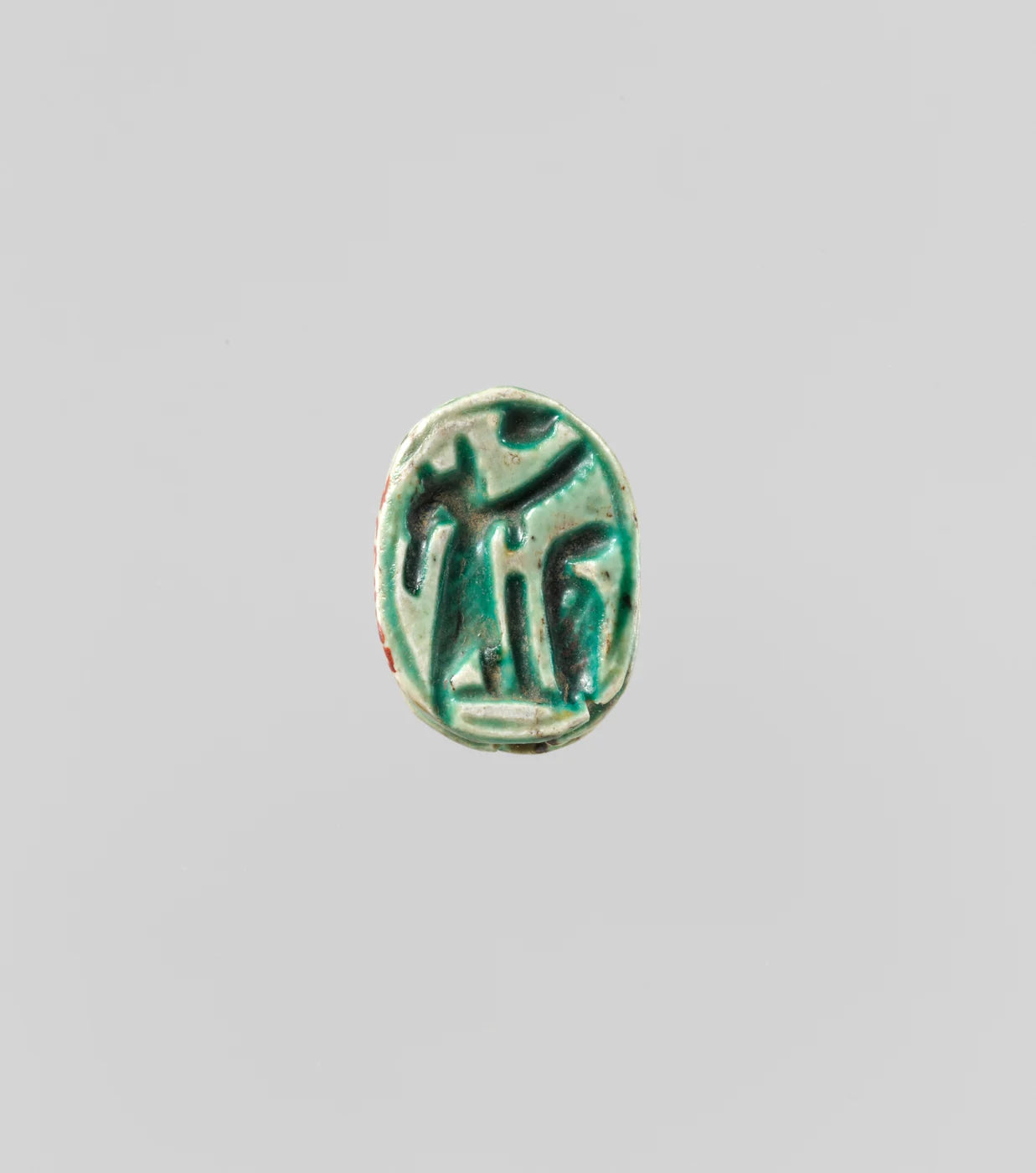
Written in signs
Name & hieroglyphs
- Transliteration
- Stẖ
- Familiar names & readings
- Set / Seth / Setekh / Sutekh
One documented spelling, shown in a simple left-to-right line. Ancient spellings and the arrangement of signs varied. Transliteration records consonants; familiar readings supply conventional vowels.
Set’s name occurs in several historical spellings, conventionally transcribed with forms such as stẖ and stš. Set, Seth, Setekh and Sutekh reflect this long history of spelling and pronunciation rather than four separate gods.
The original meaning is uncertain. Ancient interpretations could connect the name with confusion or disruption, but a theological wordplay is not necessarily the name’s linguistic origin. The spelling shown is the dictionary’s sound-sign form; other writings use the distinctive Set animal.
01 / The story
Why is Set such a complicated figure?
Set’s part in the death of Osiris and his struggle with Horus makes him an antagonist in the best-known family story. But Egyptian religion gave him other roles too. His force could protect the sun god on the dangerous journey through the night.
This is a useful reminder that Egyptian deities were not assigned permanently to modern teams of good and evil. The meaning of a god could change with the text, place and historical period. Set’s destructive strength could be feared, honoured or turned toward defence.
02 / The story
The animal and the unexpected scarab
The so-called Set animal has an unusual profile, usually described through its long muzzle, upright ears and distinctive tail. Its identity is debated; labelling it confidently as one familiar modern animal can conceal that uncertainty.
The object illustrated here is a scarab bearing a representation of winged Seth-Baal. It demonstrates how a deity could appear as a small engraved image on another symbolic object. The beetle shape belongs to the seal; the figure engraved on it tells a different part of the story.
Train your eye
Three details to notice.
An unusual muzzle
Set’s profile is often elongated and down-curving rather than the straight canine muzzle of Anubis.
Tall, angular ears
The distinctive ears help distinguish the Set animal from other animal-headed figures.
Context is essential
An inscription or museum identification is especially valuable for small, worn or composite images.
A little more understanding
Good questions.
Clear answers.
Are Set and Seth the same deity?
Yes. They are alternative spellings used for the same Egyptian god.
Was Set always considered evil?
No. He could be a dangerous opponent and a protective force, including a defender of Ra. His status also changed over time.
What animal is Set?
The identification of the Set animal remains uncertain. ‘Set animal’ is more careful than presenting one proposed species as settled fact.
What does the name Set mean?
Its original meaning is uncertain. Ancient associations with confusion are informative about his religious character, but do not establish a literal linguistic derivation.
Why are there spellings such as Sutekh and Setekh?
The name had different written and spoken forms across time and place. Modern renderings preserve aspects of those differences; they do not necessarily identify different gods.
How could Set protect the sun god?
Some traditions give him the strength to defend the solar boat against its serpent enemy. His disruptive power could therefore serve a protective purpose.
What is Set’s relationship with Horus?
Their conflict is a major theme in Egyptian stories of kingship. They could also appear together in imagery concerned with royal rule and the ordering of Egypt.
What should I look for in an image of Set?
The distinctive animal’s long curved snout and upright, squared ears are useful clues. Inscriptions are especially helpful when the figure appears in a less familiar form.
From the library to your home
Keep the story close.
Explore pieces in our shop connected with this subject. The museum objects above are historical references; shop items have their own materials and descriptions.
Explore Egyptian deitiesFollow the connections
There’s more to this story.
The evidence behind the entry
Bibliography & image credits
Museum records, language references and published research used for this entry. Name spellings and interpretations are documented here alongside the historical sources.
- Rosicrucian Egyptian Museum — Seth
- The Met — Scarab with figure of winged Seth-Baal
- Thesaurus Linguae Aegyptiae — Stẖ, lemma 148520 (accessed 20 October 2026)
- Herman te Velde — Seth, God of Confusion (1967), chapter I: name and meaning
Photograph: Scarab with Figure of Winged Seth-Baal, The Metropolitan Museum of Art, 22.1.392. Rogers Fund and Edward S. Harkness Gift, 1922. CC0 / Public domain. Resized for display; the complete photograph is preserved.