Entry 08 / Gods & goddesses
Hathor
Music, beauty and a welcome into life.
Hathor was associated with music, love, beauty, motherhood and the sky. She could appear as a cow, a woman with cow horns around a sun disk, or a human face with bovine ears. Dendera was a major centre of her worship.
Take a closer look ↓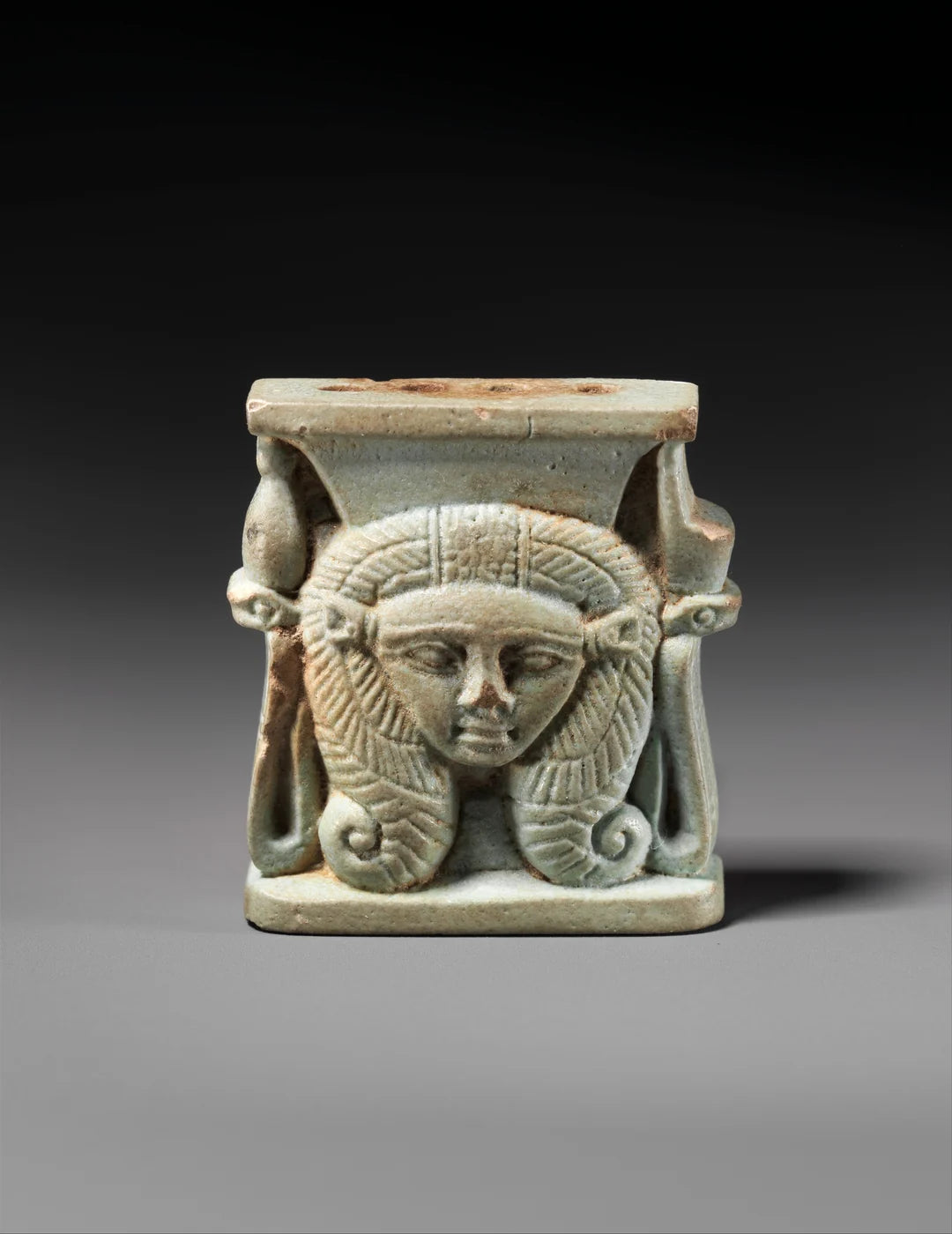
Written in signs
Name & hieroglyphs
- Transliteration
- Ḥwt-Ḥr
- Familiar names & readings
- Hathor / Hut-Hor
One documented spelling, shown in a simple left-to-right line. Ancient spellings and the arrangement of signs varied. Transliteration records consonants; familiar readings supply conventional vowels.
Hathor’s Egyptian name breaks down as ḥwt, “house” or “enclosure,” and Ḥr, “Horus”: “house of Horus.” It expresses a relationship with Horus and the divine setting in which he belongs, rather than naming an ordinary household.
The compact hieroglyph combines a falcon with the plan of an enclosure. It makes the name’s two elements visible together. Hathor is the familiar form in English; Hut-Hor is a conventional way of making the Egyptian components easier to recognise.
01 / The story
What made Hathor so widely loved?
Hathor’s associations bring religious life close to experiences people recognise: music, celebration, attraction and care. Beauty and pleasure could have sacred significance. Mirrors and objects connected with adornment therefore belong to her world as well as monumental temple images.
Her roles also reached beyond an uncomplicated image of joy. Like other goddesses associated with the Eye of Ra, she could embody the sun god’s protective power. A deity’s welcoming and formidable aspects could coexist within Egyptian thought.
02 / The story
Recognising the face of Hathor
The amulet shown here concentrates her identity into a head. Cow ears are an important clue when the face is human. In other objects, the horns curve around a sun disk. These details let an artist evoke the goddess without showing a complete cow.
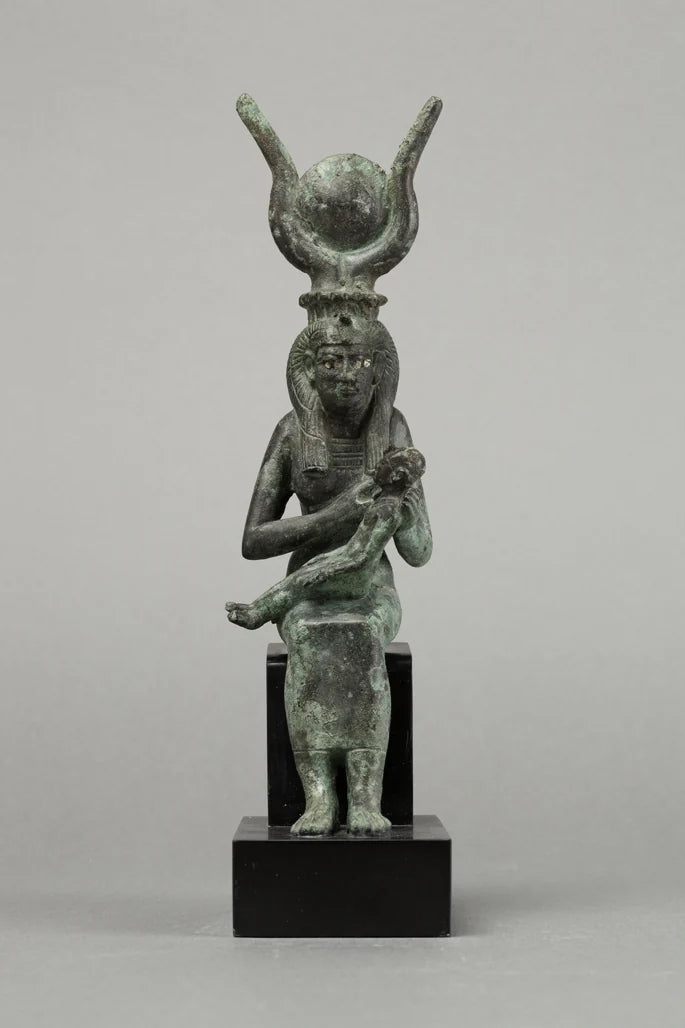
Hathor’s imagery overlaps with that of Isis. If a figure wears the horn-and-disk crown, look beyond the crown: the inscription, a child, the object’s original setting and other attributes may settle the identification. A shared visual feature can express a connection between goddesses rather than a mistake.
Train your eye
Three details to notice.
Bovine ears
A frontal human face with cow ears is a distinctive Hathoric image.
Horns and a disk
This familiar crown is associated with Hathor, but was also adopted in images of Isis.
Musical connections
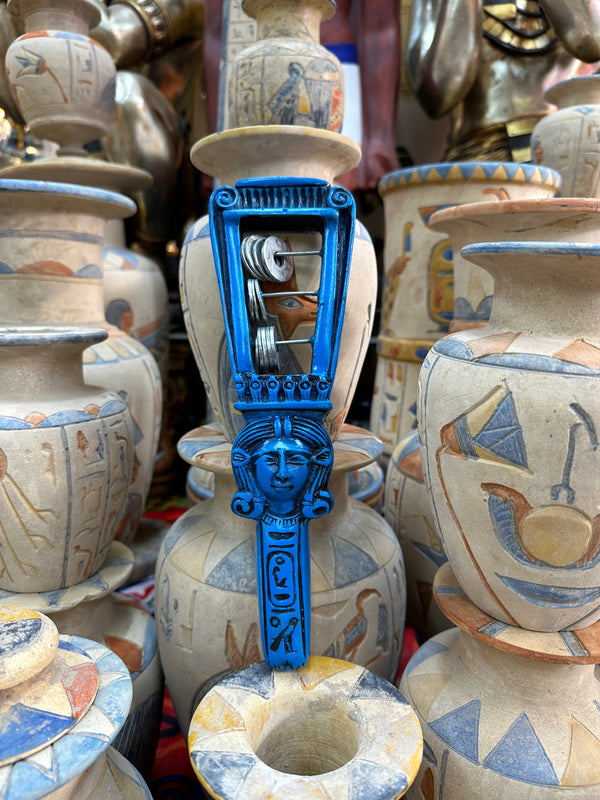
Sistra and other objects used in ritual music belong to Hathor’s wider visual world.
A little more understanding
Good questions.
Clear answers.
Was Hathor a cow goddess?
Cow imagery is central to her representations, but she also appears as a woman or a human face with cow ears. Her roles extend beyond one animal form.
Was Hathor the goddess of love?
Love and beauty were among her associations, alongside music, motherhood, the sky and protection.
Where was Hathor worshipped?
Dendera was a major centre. Her worship and imagery extended beyond that one place.
What does Hathor’s name mean?
It means “house of Horus”: ḥwt is a house or enclosure, and Ḥr is Horus. The compact hieroglyph combines an enclosure with the Horus falcon.
Are Hathor and Isis the same goddess?
They are distinct deities whose imagery and roles can overlap. Both can wear cow horns and a solar disk, so an inscription or scene may be needed to identify them.
What is a sistrum?
A sistrum is a ritual rattle closely associated with Hathor. Its use connects music and ceremony with the goddess’s worship.
Why do some images of Hathor have cow ears?
Bovine features are part of her established imagery. She may appear as a cow, a woman with cow ears or a woman with a horned headdress.
Was Hathor connected with the afterlife?
Yes. Her roles extended beyond music, joy and motherhood into funerary belief. Egyptian deities could operate across several parts of life and the cosmos.
From the library to your home
Keep the story close.
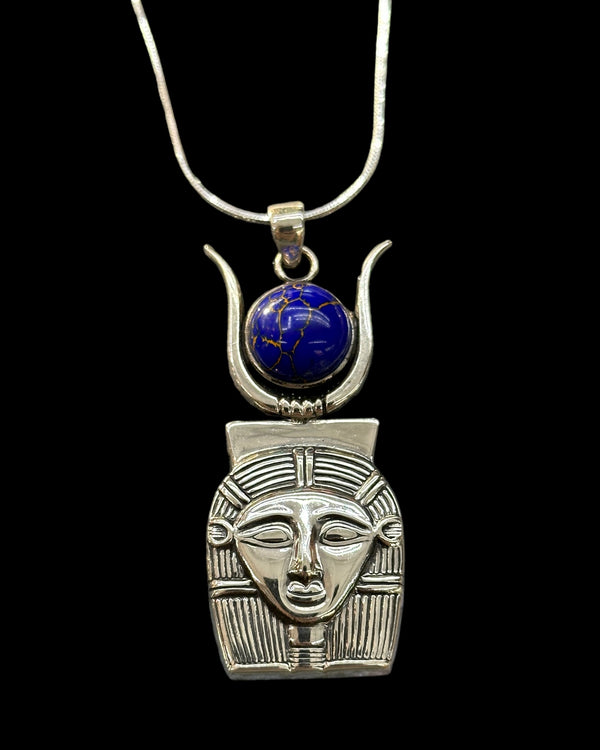
Explore pieces in our shop connected with this subject. The museum objects above are historical references; shop items have their own materials and descriptions.
Explore the Hathor collection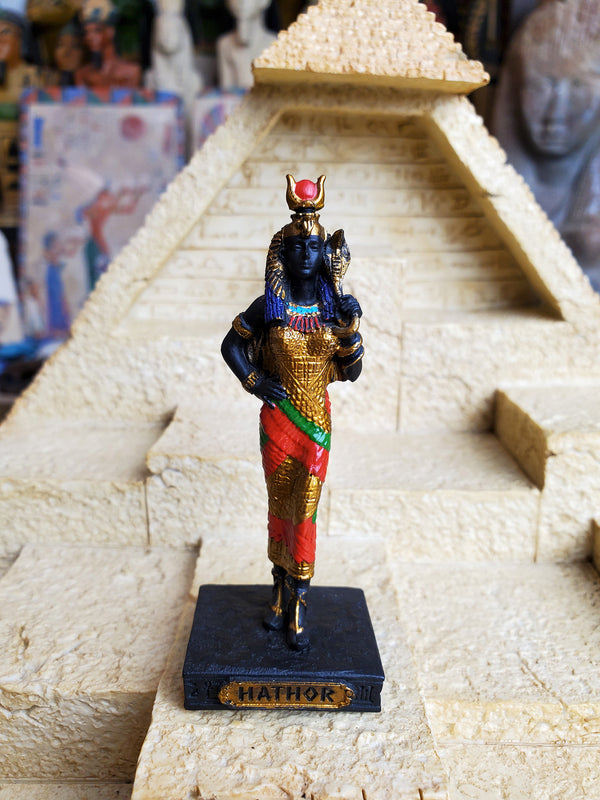
Follow the connections
There’s more to this story.
The evidence behind the entry
Bibliography & image credits
Museum records, language references and published research used for this entry. Name spellings and interpretations are documented here alongside the historical sources.
- Rosicrucian Egyptian Museum — Hathor
- The Met — Hathor head amulet
- Thesaurus Linguae Aegyptiae — Ḥwt-Ḥr, lemma 99960 (accessed 20 October 2026)
- Museo Egizio — Fragment of a stela with the Hathor-cow, Suppl. 12365
Photograph: Hathor Head Amulet, The Metropolitan Museum of Art, 26.7.1041. Purchase, Edward S. Harkness Gift, 1926. CC0 / Public domain. Resized for display; the complete photograph is preserved.