Entry 21 / Objects of the afterlife
Shabtis
Small figures with work to do in the next world.
Shabtis were funerary figurines intended to carry out work for the deceased in the afterlife. Also called shawabtis or ushabtis, they were made in materials including wood, stone and faience. Many carry tools and a text instructing them to answer when their owner is summoned to labour.
Take a closer look ↓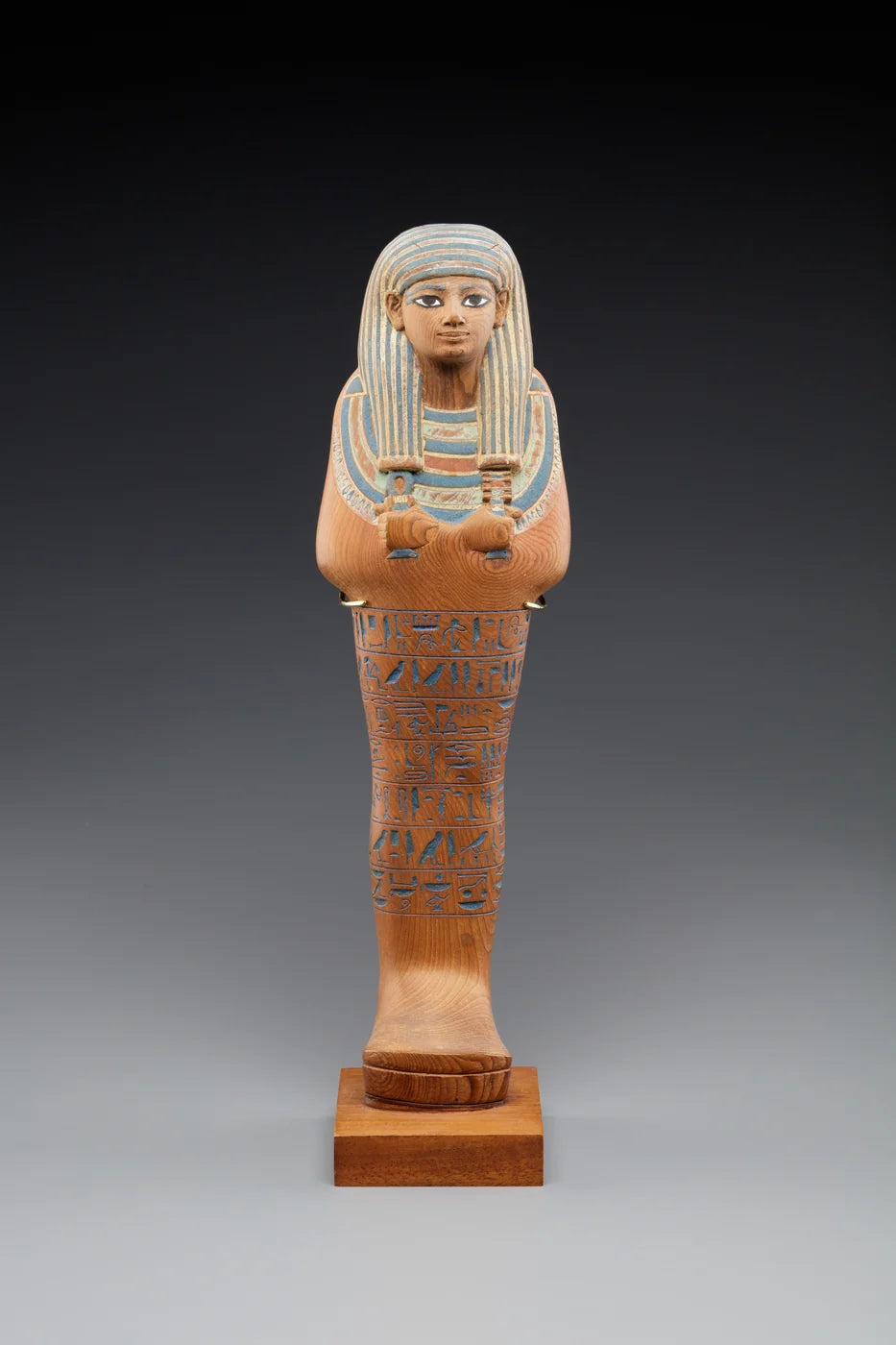
Written in signs
Name & hieroglyphs
- Transliteration
- Šꜣbtj
- Familiar names & readings
- Shabti / Shawabti / Ushabti
One documented spelling, shown in a simple left-to-right line. Ancient spellings and the arrangement of signs varied. Transliteration records consonants; familiar readings supply conventional vowels.
Shabti preserves an ancient Egyptian word, šꜣbtj. Its earliest derivation is uncertain; a connection with a word for a stick has been suggested. Shawabti is another historical form encountered in museum catalogues.
The later term ushabti was understood in relation to wšb, “to answer,” which suits figures expected to respond when their owner was called to work in the afterlife. “Answerer” therefore explains the later interpretation particularly well, but should not be presented as the certain original derivation of every earlier form. The signs shown spell shabti.
01 / The story
What was a shabti supposed to do?
The afterlife was imagined through familiar needs and activities, including agricultural work. A shabti could answer a summons in place of its owner. The inscription on many examples makes that responsibility explicit; the figure is an active helper within the burial’s religious provisions.
The idea and its material forms developed over time. A burial might contain different numbers and kinds of figures. Some are highly individual carvings; others were produced in large groups. Quality of carving alone does not determine whether an object fulfilled the role of a shabti.
02 / The story
Reading the hands and the inscription
A wrapped body can resemble an image of Osiris, but the tools and text help distinguish the funerary worker. Look for hoes, a basket or other equipment, then examine the inscription for the owner’s name and the work-related spell.
The wooden figure shown here is a shabti of Yuya. It provides a useful contrast to the blue-green faience examples many visitors first encounter. Shabti names, materials and styles change across collections; their intended task is the thread that connects them.
Train your eye
Three details to notice.
Working equipment
Hoes or a basket can signal the agricultural tasks expected of the figure.
Text around the body
An inscription may name the owner and direct the figure to answer a call to work.
Varied materials
Wood, stone and faience examples can look very different while serving a related funerary purpose.
A little more understanding
Good questions.
Clear answers.
Are shabtis gods?
They are generally funerary helpers or substitutes for the deceased, not a separate class of gods. Their appearance can draw on funerary divine imagery.
What is the difference between shabti and ushabti?
Both terms are used for these funerary figures. Usage and terminology developed over time; museum labels may also use shawabti.
Are all shabtis blue?
No. Blue-green faience is familiar, but shabtis were also made from wood, stone and other materials. The illustrated example is wooden.
What does the word shabti mean?
Shabti preserves an Egyptian term whose earliest derivation is uncertain. The later form ushabti was understood as an “answerer,” linking the figure with responding to work demands.
Could a shabti’s name be written in hieroglyphs?
Yes. The Egyptian word šꜣbtj has attested spellings, including sound signs followed by a figure classifier. Individual shabtis may also carry the name of their owner.
What work were shabtis expected to do?
Their funerary texts called on them to perform labour for their owner in the afterlife, especially agricultural tasks. Tools in their hands make that purpose visible.
Why do some shabtis carry hoes and baskets?
These are tools for the work the figures were expected to undertake. Their equipment connects the image directly with the promises made in the shabti formula.
How many shabtis could be placed in a burial?
The number varied over time and between burials. Some later sets included 365 workers with additional overseers, while earlier or smaller sets could contain far fewer.
From the library to your home
Keep the story close.
Explore pieces in our shop connected with this subject. The museum objects above are historical references; shop items have their own materials and descriptions.
Explore Egyptian statuesFollow the connections
There’s more to this story.
The evidence behind the entry
Bibliography & image credits
Museum records, language references and published research used for this entry. Name spellings and interpretations are documented here alongside the historical sources.
- The Met — Shabti of Yuya
- The Met — An artisan’s tomb in New Kingdom Egypt
- Fitzwilliam Museum — Painted limestone shabti of Sennedjem
- Thesaurus Linguae Aegyptiae — Šꜣbtj, lemma 153120 (accessed 20 October 2026)
- UCL Digital Egypt — Shabtis: name, forms and funerary purpose
Photograph: Shabti of Yuya, The Metropolitan Museum of Art, 30.8.57. Theodore M. Davis Collection, Bequest of Theodore M. Davis, 1915. CC0 / Public domain. Resized for display; the complete photograph is preserved.