Entry 15 / Symbols & amulets
Scarab
A beetle, a sunrise, a promise of renewal.
The scarab is a beetle-shaped form associated with becoming and renewal in ancient Egypt. Scarabs could serve as amulets, seals and funerary objects. A heart scarab had a particular role in burial and judgment; not every small beetle-shaped object was a heart scarab.
Take a closer look ↓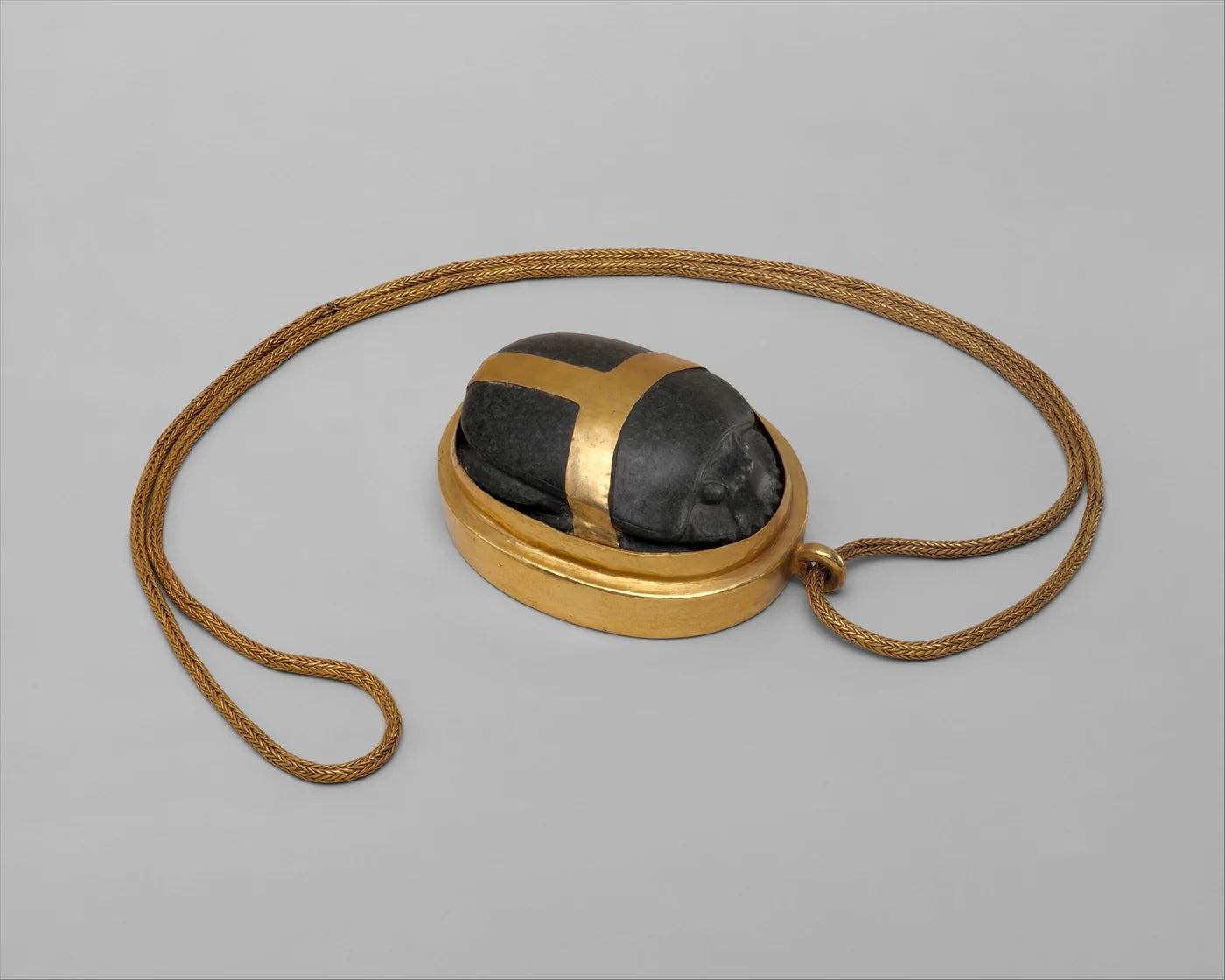
Written in signs
Name & hieroglyphs
- Transliteration
- Ḫprr
- Familiar names & readings
- Kheperer — the Egyptian beetle word
One documented spelling, shown in a simple left-to-right line. Ancient spellings and the arrangement of signs varied. Transliteration records consonants; familiar readings supply conventional vowels.
The Egyptian beetle word ḫprr is conventionally read kheperer. It is associated through sound and imagery with ḫpr, “to come into being” or “to become,” and with Khepri, the rising-sun deity. These are related ideas, not three interchangeable translations.
Scarab is the modern English name, ultimately from Latin scarabaeus, “beetle.” The spelling shown gives the Egyptian word, ending with a beetle sign and a short stroke. The beetle was therefore both an animal in the landscape and a sign capable of carrying language and religious meaning.
01 / The story
What did the scarab symbolise?
Scarab imagery connects the natural world with ideas about the renewal of life. The beetle was associated with Khepri, a form of the rising sun. That association made a small creature an effective image for something on a cosmic scale: the return of light.
Its shape was also practical. Many scarabs have a rounded beetle back and a flat underside bearing a name, image or inscription. Turning an object over can reveal a second function as a seal or a message that is invisible from above.
02 / The story
What makes a heart scarab different?
Heart scarabs belong specifically to funerary practice. They were placed with the deceased and often carried a spell asking the heart not to oppose its owner during judgment. Their purpose connects them with the weighing of the heart and the hope for a favourable outcome.
The illustrated example belonged to Hatnefer and combines a dark stone scarab with gold. It is a particular person’s funerary object, not a model for every scarab ever made. Other examples were smaller, used different materials or carried entirely different inscriptions.
Train your eye
Three details to notice.
The beetle’s back
Look for the divisions of the wing cases and the head at one end.
An underside worth reading
A flat base may carry a seal design, royal name or religious text.
Function before colour
Material and colour vary. Size, inscriptions and find context are better clues to an object’s purpose.
A little more understanding
Good questions.
Clear answers.
Does a scarab mean good luck?
That is a broad modern shorthand. Ancient associations include renewal and protection, while individual objects also served specific sealing or funerary purposes.
Is every scarab a heart scarab?
No. Heart scarabs are a particular funerary type. Many other scarabs were amulets or seals.
Was a scarab an actual beetle?
The objects take the shape of a beetle. Surviving scarab amulets and seals were made from materials such as stone, faience and metal, not simply preserved insects.
What did Egyptians call the scarab beetle?
One Egyptian word is ḫprr, conventionally read kheperer. Scarab is the modern English name, ultimately from Latin scarabaeus.
What connects scarabs with becoming or rebirth?
The beetle word ḫprr is associated with ḫpr, “to come into being.” Its imagery also connects with Khepri and the renewal of the rising sun.
Who is Khepri?
Khepri is a solar deity associated with the rising sun and represented through scarab imagery. The deity’s name and the beetle word are related but not identical.
Why do some scarabs have flat, engraved undersides?
Many served as seals or seal-like objects. Their undersides could carry names, designs or other signs; the inscription helps explain a particular object.
Are scarabs only funerary objects?
No. Scarabs had several uses, including seals and amulets. Heart scarabs form a specific funerary category rather than defining every scarab.
From the library to your home
Keep the story close.
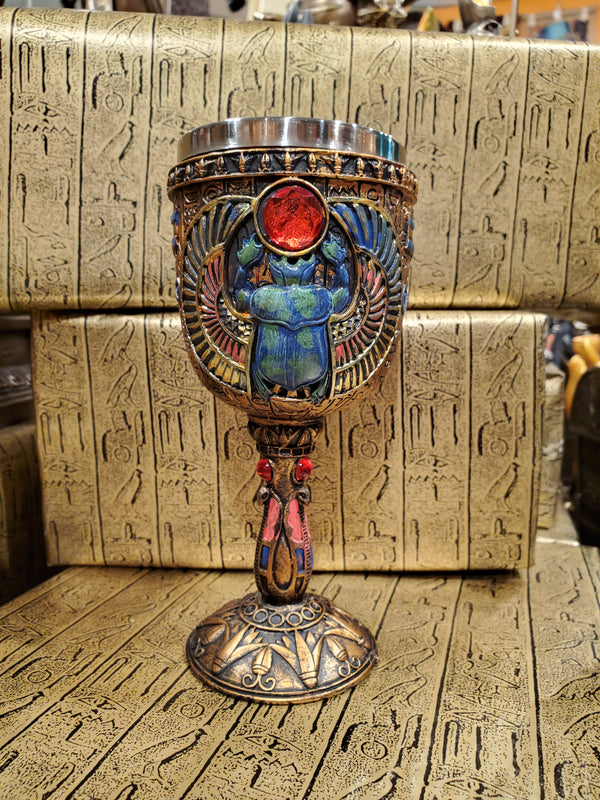
Explore pieces in our shop connected with this subject. The museum objects above are historical references; shop items have their own materials and descriptions.
Explore the Scarab collection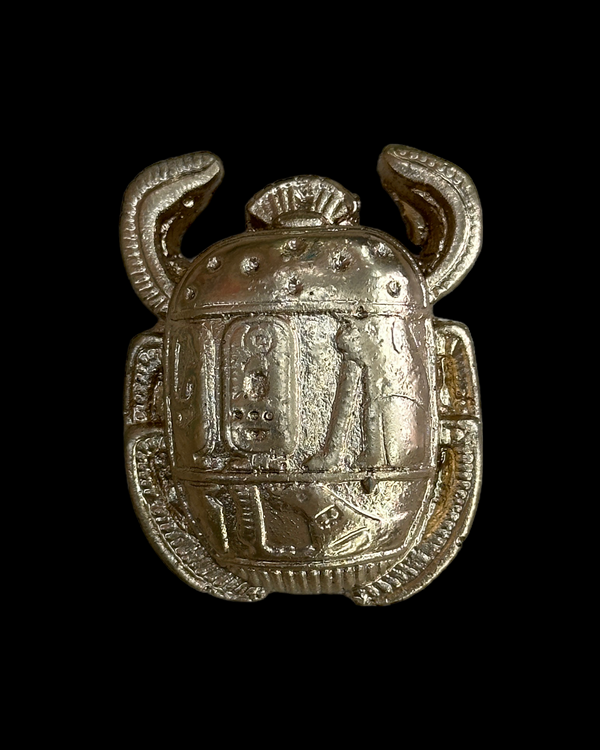
Follow the connections
There’s more to this story.
The evidence behind the entry
Bibliography & image credits
Museum records, language references and published research used for this entry. Name spellings and interpretations are documented here alongside the historical sources.
- The Met — Ancient Egyptian amulets
- The Met — Heart scarab of Hatnefer
- The Met — Heart scarab with a human head and judgment spell
- Thesaurus Linguae Aegyptiae — Ḫprr, lemma 116410 (accessed 20 October 2026)
- Oxford Advanced Learner’s Dictionary — Scarab: word origin
Photograph: Heart Scarab of Hatnefer, The Metropolitan Museum of Art, 36.3.2. Rogers Fund, 1936. CC0 / Public domain. Resized for display; the complete photograph is preserved.