
In Queen Neferu’s tomb at Deir el-Bahri, a sculptor took the trouble to carve a sack. You can still see the cords crossing its bulging sides. A wooden lever tightened the sack until liquid ran out. Egyptologists think the material inside may have been flowers steeped in oil. Four thousand years later, a piece of limestone small enough to hold in one hand lets us see someone at work on the oldest problem in perfumery. How do you keep the smell of a flower after its petals are gone?
The people who answered that question in Egypt left traces in surprising places. Some survive in burial linen. Others turn up in a king’s gift to his wives, in a Greek account of Cleopatra’s arrival by river, and in a letter to a medieval perfume seller. For our family, who bring Egyptian perfume oils to Calgary, the most interesting part of the story is how much of it belongs to the people who made the fragrances.
Before the pharaohs, a scent caught in linen
Some of Egypt’s earliest evidence for making aromatic mixtures comes from Mostagedda in Upper Egypt. Researchers studied linen from graves dating as far back as the fifth millennium BCE, long before the pyramids. The threads retained traces of a fatty or oily base, conifer resin and an aromatic plant extract. The proportions mattered. Fat or oil made up most of the mixture, with much smaller amounts of the fragrant materials.
These were preparations for the dead. Burial linen can tell us what someone mixed and where they applied it. An oil worn on an ordinary morning and washed off that evening would be much harder to trace. A second discovery brings us close to the hands of one of those early makers. On the wrappings of a man who lived around 3700–3500 BCE, scientists identified plant oil, heated conifer resin, an aromatic extract and gum or sugar. Someone had selected the materials, worked them together and dressed the linen with the result.
By the Old Kingdom, individual oils had names worth carving in stone. A nobleman called Ankhwadjes had an alabaster offering slab with seven round hollows for the seven sacred oils of funerary ritual. Look just above the hollows in the photograph. Each oil has its own label, and green pigment still clings to the carved signs. An attendant looking down at this slab could tell where each offering belonged.

How a perfumer caught the scent of flowers
An Egyptian perfumer’s choice of oil began with its own smell. The Egyptian Museum in Cairo describes the use of mild oils such as moringa to carry other aromas. Flower petals could steep in oil until the oil took up their scent. Other fragrant materials could be warmed in oil or fat. A runny preparation could be poured. A firmer ointment, often called an unguent, could be lifted from its jar and spread with the fingers.
That brings us back to Neferu’s press. In the surviving carving, the net around the sack takes up nearly as much room as the part of the worker we can see. Tightening the sack squeezed the liquid free of the spent material. A press like this could also be used for wine or oil. The Met’s curators read the figure of a woman beside it as a clue that the artist may have shown perfume production. Neferu herself bore a title that praised the fragrance she brought to a hall. On her tomb wall, the person doing the pressing had a place in that story too.

One flower you can recognise throughout Egyptian art is the blue water lily, often called the blue lotus. Its petals close at night and open in the morning, a habit that made it an emblem of the returning sun. That is the flower behind the name of our Blue Lotus Perfume Oil, a modern floral with a cool, watery opening.
Hatshepsut’s ships and a king’s gift
In the fifteenth century BCE, Hatshepsut sent an expedition across the Red Sea to Punt. She had the voyage recorded on the walls of her temple at Deir el-Bahri. Among the cargo were living incense trees. Think of the difference between bringing resin home in a sack and getting a tree home alive. The second cargo offered the possibility of another harvest. It also gives some idea of what a reliable supply of fragrance was worth to the Egyptian court.
At the very same temple, archaeologists found ointment jars buried in foundation deposits. One carries an inscription in which Hatshepsut dedicates her offering to the god Amun. Several jars still held traces of scented fat. In burying them, the Egyptians provided for the daily anointing of the temple’s sacred images in perpetuity.
Perfume also belonged to the pleasures of company. In New Kingdom paintings from Theban tombs, attendants offer scented oil to guests from little stone jars. A vessel associated with the burial of three wives of Thutmose III gives those painted jars a satisfying weight and scale. It stands just under eleven centimetres high. Gold leaf picks out the rim and foot of the dark stone, and the king’s name identifies it as a royal gift. You could balance the whole thing in your palm.

Kyphi at dusk and the perfume of Mendes
What might an Egyptian temple have smelled like at the end of the day? The Greek writer Plutarch gives one answer. In his account of Egyptian worship, priests burned a compound called kyphi at nightfall. His version included raisins, wine, honey, myrrh and juniper among sixteen ingredients. He describes sacred words being read aloud while the perfumers mixed them. For the people making this offering, the words belonged to its preparation as surely as the myrrh did.
A recipe for kyphi also survives on the walls of the temple at Edfu. When researchers prepared versions of it for an exhibition at the Egyptian Museum in Cairo, they had to make choices about plant names whose meanings are still debated. If you are picturing the temple at dusk, imagine fragrance rising from a burner. Kyphi in that scene is incense. A perfume oil worn on the body offers a different encounter with scent, usually to someone standing much closer.
For wearable luxury, one of the great names was Mendesian perfume, named for Mendes in the Nile Delta. Greek and Roman writers knew it, and modern researchers have experimented with its myrrh and cinnamon notes. Even the base oil raises questions. One candidate is oil from the moringa tree. One ancient author, Theophrastus, describes heating oil for ten days and nights to prepare it to take on scent. Choosing a different oil, or even a different kind of myrrh, changes the perfume a modern reconstruction puts under your nose.
And Cleopatra? When she sailed up the river Cydnus to meet Mark Antony, Plutarch tells us that people on the banks could smell incense from her vessel. He wrote generations after the event and gave the queen purple sails, silver oars and musicians to accompany the scent. He left us a splendid story about making an entrance. The name of the oil on Cleopatra’s skin, if she wore one that day, is still her secret.
From a perfume seller in Fustat to the jasmine fields
Perfume making in Egypt carried on under Roman rule. At Buto in the northwestern Delta, excavators found sets of flasks and evidence that local potters devoted part of their production to containers for aromatics. Every bottle adds another trade to the picture. A perfumer with a batch ready to sell needed someone who could supply the vessels.
By about 1140 CE we can even address a perfume seller by name. A letter preserved in the Cairo Geniza was sent from Alexandria to Abu Sa‘id al-‘Attar, a perfumer in Fustat, now part of Cairo. The sender wanted news of seven manuscripts. Among them were volumes of a pharmaceutical handbook in Arabic translation. It is a wonderfully ordinary errand to have survived the centuries. For once we meet a man in the perfume trade on a day when someone wanted to talk to him about books.
Today, one of the places to follow your nose is the Nile Delta village of Shubra Balula. During the jasmine harvest, pickers gather the blossoms before sunrise and take them to nearby processors. There the flowers yield an aromatic waxy material known in perfumery as a concrete, from which jasmine absolute can be obtained. The village’s commercial jasmine fields have their own, comparatively recent history. Their place in Egyptian perfumery belongs to the growers and pickers working them now.
Three Egyptian perfume oils to wear today
Our family’s business began in Egypt. Emad Adly and Carol Card brought it to Calgary in 1990, and today Jacob works alongside them. We want the oils on our counter to represent the best of Egyptian perfumery. Ours are made in Egypt with natural parfum in a jojoba oil base. They are alcohol-free and hand-poured into glass roller bottles. That is what we mean by pure perfume oil. The roller lets you try a little on one wrist and come back to it as the opening gives way to the heart of the fragrance.
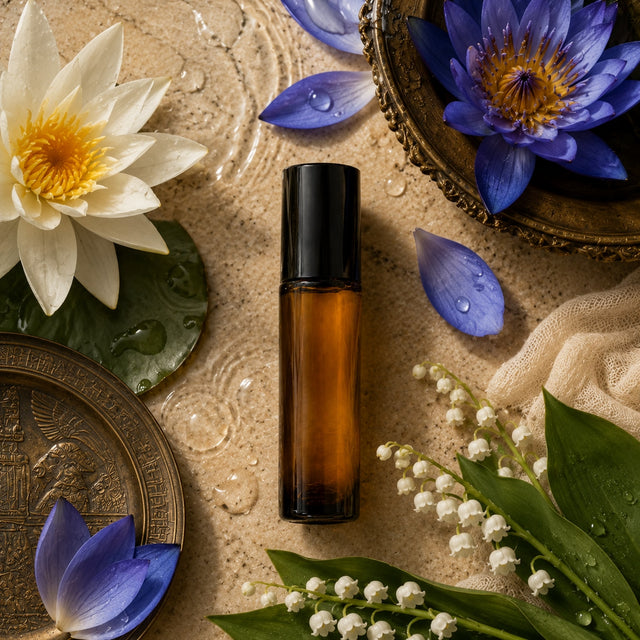
Blue Lotus
For a fresh floral. Water lily opens the fragrance, blue lotus softens the heart, and lily of the valley gives the finish a green edge.
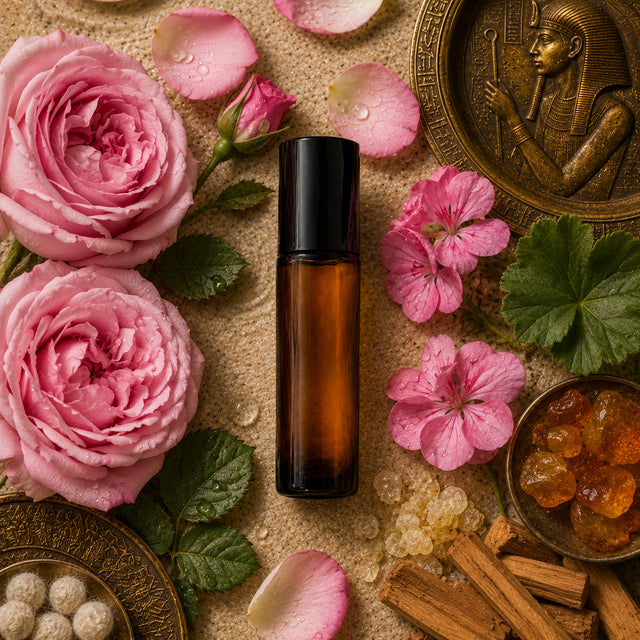
Egyptian Rose
For someone who loves a freshly opened rose. The rose note stays with you from the first touch, with a little honeyed sweetness as it settles.
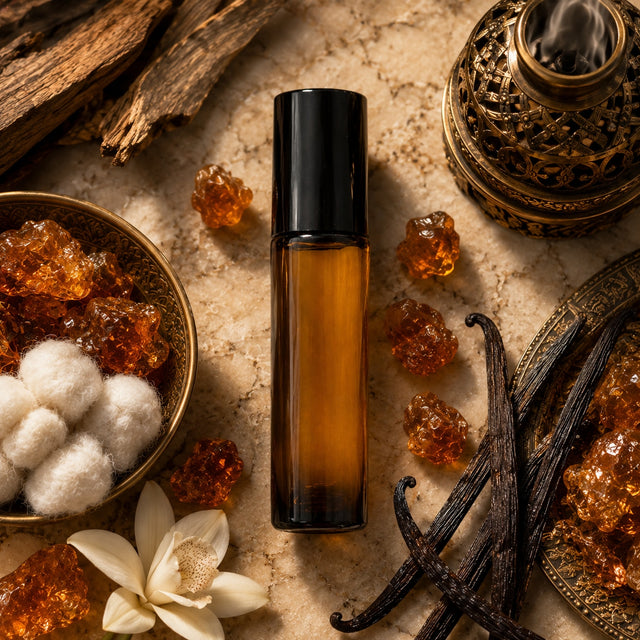
Amber
For the reader drawn to the warmth of Mendesian perfume. This modern blend pairs amber with vanilla and musk for a softer, sweeter take on resinous warmth.
If you’re torn between two, think about what you’d most like to catch on your sleeve at the end of the day. You can browse by scent family in our Egyptian perfume oil collection or use our fragrance quiz to find a starting point.
Frequently asked questions
How far back do Egyptian perfume oils go?
Archaeologists have found aromatic mixtures in Upper Egyptian burial linen dating to the fifth millennium BCE. The earliest evidence tells us about funerary balms. By the Old Kingdom we have individually named ritual oils, and later tomb paintings show perfumed oil being offered to living guests.
What did ancient Egyptian perfume smell like?
It depended on the preparation. Myrrh and cinnamon are clues to the warm, spicy character of Mendesian perfume. Flower-infused oils offer another possibility. The origin of a resin, the choice of base oil and the length of heating could all affect what reached the wearer’s nose.
Can I buy the perfume Cleopatra wore?
Her personal formula is unknown. Researchers have recreated possible versions of the Mendesian perfume famous in her era. If that description appeals to you, a warm, resinous fragrance is a good place to start exploring your own tastes.
Is a pure perfume oil the same as an essential oil?
They serve different purposes. An essential oil is an aromatic extract from a plant. Our perfume oils are finished fragrances made to wear, with natural parfum blended into jojoba. Names such as Blue Lotus describe the scent you’ll experience.
How do I try a perfume oil for the first time?
Roll a small amount onto one wrist and give it time to settle before deciding how you like it. A 3 ml roller is a good way to get to know a fragrance over several wears. Choose 10 ml when you’ve found the one you keep reaching for.
Sources and image credits
- The earliest balms. Jana Jones and colleagues, study of the Mostagedda burial textiles (2014) and chemical analysis of a predynastic Egyptian mummy (2018).
- The seven oils and the flower press. The Metropolitan Museum of Art, Offering slab for seven oils of Ankhwadjes and Relief fragment of a perfume press.
- Oil bases, Edfu’s kyphi and the flasks of Buto. Egyptian Museum of Cairo and Université Paul-Valéry Montpellier 3, Perfumes of Ancient Egypt Through Ages (2024), exhibition booklet, sections 2 and 6. Egyptian Museum exhibition record.
- The blue water lily. The Metropolitan Museum of Art, chalice fragment with blue water lilies.
- Hatshepsut and Punt. Egypt’s Ministry of Tourism and Antiquities, Hatshepsut Temple and Suez National Museum guide. The Met, ointment jar from Hatshepsut’s temple.
- Banquet guests and royal gifts. The Metropolitan Museum of Art, Ointment jar and lid naming Thutmose III.
- Kyphi and Mendesian perfume. Plutarch, Isis and Osiris, translated by Sean Coughlin. Czech Academy of Sciences, interviews with the Alchemies of Scent research team.
- Cleopatra on the Cydnus. Plutarch, Life of Antony, chapter 26, translated by Bernadotte Perrin.
- The perfumer in Fustat. Princeton Geniza Project, letter T-S 13J14.25, circa 1140 CE.
- Egypt’s jasmine trade. Sarah Elhosary, “The Flowers Behind the Fragrance,” Al-Ahram Weekly. A. Fakhry & Co., how Egyptian jasmine concrete and absolute are produced.
- Our family and fragrances. Son of the Pharaoh, our family’s story, perfume oil ingredients and sizes, and the product notes for Blue Lotus, Egyptian Rose and Amber.
Images. The three historical photographs are from The Metropolitan Museum of Art’s Open Access collection (public domain, CC0). Product images are from Son of the Pharaoh.