Son of the Pharaoh Journal · Egyptian history
Bastet: the goddess with a cat's gaze
Meet Egypt’s feline protector. Follow her story from a watchful gaze to a river festival—and try the art of wrapping a sacred cat.

A cat can fill a room without making a sound.
She settles by the doorway. Her ears turn towards something you cannot hear. She seems perfectly at ease, yet nothing escapes her.
That mixture of softness and watchfulness is a lovely place to begin with Bastet, one of ancient Egypt’s most recognisable goddesses. You may have seen her as an elegant seated cat, or a woman with a feline head. Behind those familiar images is a story of protection, celebration, and the wish to keep something precious safe.
01 / Meet the goddess
More than a goddess of cats.
Bastet was an Egyptian goddess associated with protection, fertility, and nurturing care. Cats were sacred to her, but her identity reached beyond the animal itself. Her images could express both the strength of a guardian and the gentleness of a mother.
Her feline face also changed across Egypt’s long history. Earlier traditions presented a formidable lioness; later, the domestic cat became especially familiar. These qualities could coexist. As The Met explains, a lioness head could emphasise fierce protection, while a cat’s head expressed a more peaceful nature.
She was also connected with the sun god Re, often called Ra. LACMA’s account of Bastet describes her as his daughter and traces her protective role from kingship to the household.
You do not need to know an entire pantheon to recognise the idea: care can be tender, and it can be powerful.


Look at the ears. Then the details.
In the seated cat above, the upright ears and balanced posture create a sense of attention. Its collar adds another layer: this is an animal given a special presence through art.
The cat-headed woman tells the story differently. She carries an aegis, a protective emblem shaped like a collar with a divine head, and a basket. Other figures of Bastet hold a sistrum, a ritual rattle. Protection and music belong in the same picture.
Small cat figures could be dedicated at temples or placed with cat mummies. The Met’s seated cat belongs to that wider world of sacred gifts. An object could give a prayer a lasting physical form.
02 / Follow the river
A whole city
celebrating a cat goddess.
Bubastis · The Nile Delta · Modern Tell Basta
Imagine hearing the boats
before you could see them.
Bastet’s great centre of worship was Bubastis, in the green waterways of the Nile Delta. The place is known today as Tell Basta, near Zagazig. Her temple stood at the heart of a city whose history stretched across millennia.
The Greek writer Herodotus describes people travelling there by boat, singing, clapping, and playing rattles and flutes. His account is lively: there is dancing, teasing between travellers and people on the riverbanks, and plenty of wine at the festival.
Writing in the fifth century BCE, he gives an enormous attendance figure of 700,000. It is best read as his reported number, not a verified headcount. Even with that caution, his description gives us a vivid sense of celebration.
Archaeology adds another view. The Tell Basta Project describes sacred canals around the temple, where the goddess’s cult statue travelled in a ceremonial boat during festivals.
For a moment, let ancient Egypt be noisy and joyful: water against a hull, a rhythm kept by many hands, people making a journey together because it mattered to them.
03 / A gift with a lasting purpose
Why mummify a cat?
A mummy is a body preserved after death. In Egypt, preservation could give religious care a lasting form. Animals had a place in that world as well as people.
Some animal burials were for cherished pets. Many cat mummies, however, were votive offerings: gifts dedicated in a religious setting, perhaps to ask for help or express thanks. A cat associated with Bastet could become part of a person’s approach to the goddess.
The history also has a difficult side. Research on animal mummies shows that many animals were deliberately killed for offerings. These burials were not all memorials to pets that had died naturally.
We can acknowledge that honestly while looking closely at the extraordinary care taken with linen, pattern, and form. On this surviving mummy, two shades of cloth create a checkerboard design. Someone folded those small strips by hand.

Materials in close-up · Original illustrations
Salt, linen, and the work of preservation.

Wrapping was only part of mummification. One useful material was natron, a natural mixture of salts that draws out moisture. Egyptians collected it in places such as Wadi el-Natrun, west of the Nile Delta. A bag of natron preserved at The Met brings this practical material surprisingly close.

Drying took time. In the general process described by the Smithsonian, the salts were cleared away before the linen wrapping began. Animal preparations varied, and we cannot reconstruct every cat mummy’s treatment from that human example. The McClung Museum’s study of cat mummies describes linen bandages, padding, modelled heads, and painted features.

Linen is made from flax fibres. Flexible strips could follow the body’s shape, while folded layers gave a sacred bundle its finished form. On some surviving cat mummies, light and dark cloth became elaborate decoration—a meeting of practical skill and religious care.
How did familiar materials become something sacred? Let’s slow down and explore the craft, one small step at a time.
A little hands-on history · Five gentle stages
The sacred cat workshop.
- 1Preserve
- 2Wrap
- 3Pattern
- 4Paint
- 5Dedicate

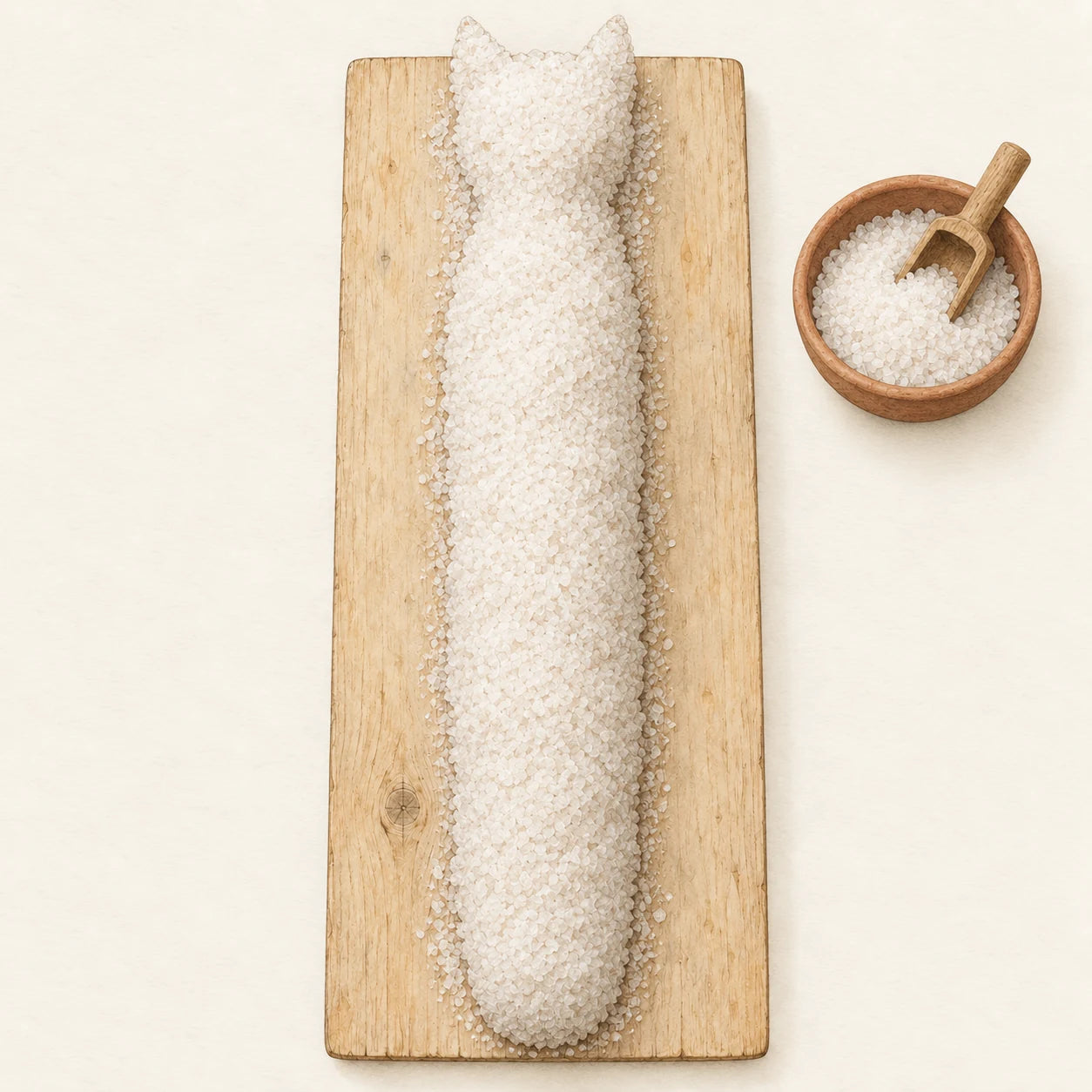
01 / Preserve
Begin with natron.
Choose the drying salt; each of three sprinkles reveals a little more.
Choose the drying salt; each of three sprinkles reveals a little more.
Natron is a natural mixture of salts, found in places such as Wadi el-Natrun, west of the Nile Delta.
These salts draw out moisture, helping preserve the body by drying it.
Drying took time. The salts were cleared away before the linen wrapping began.
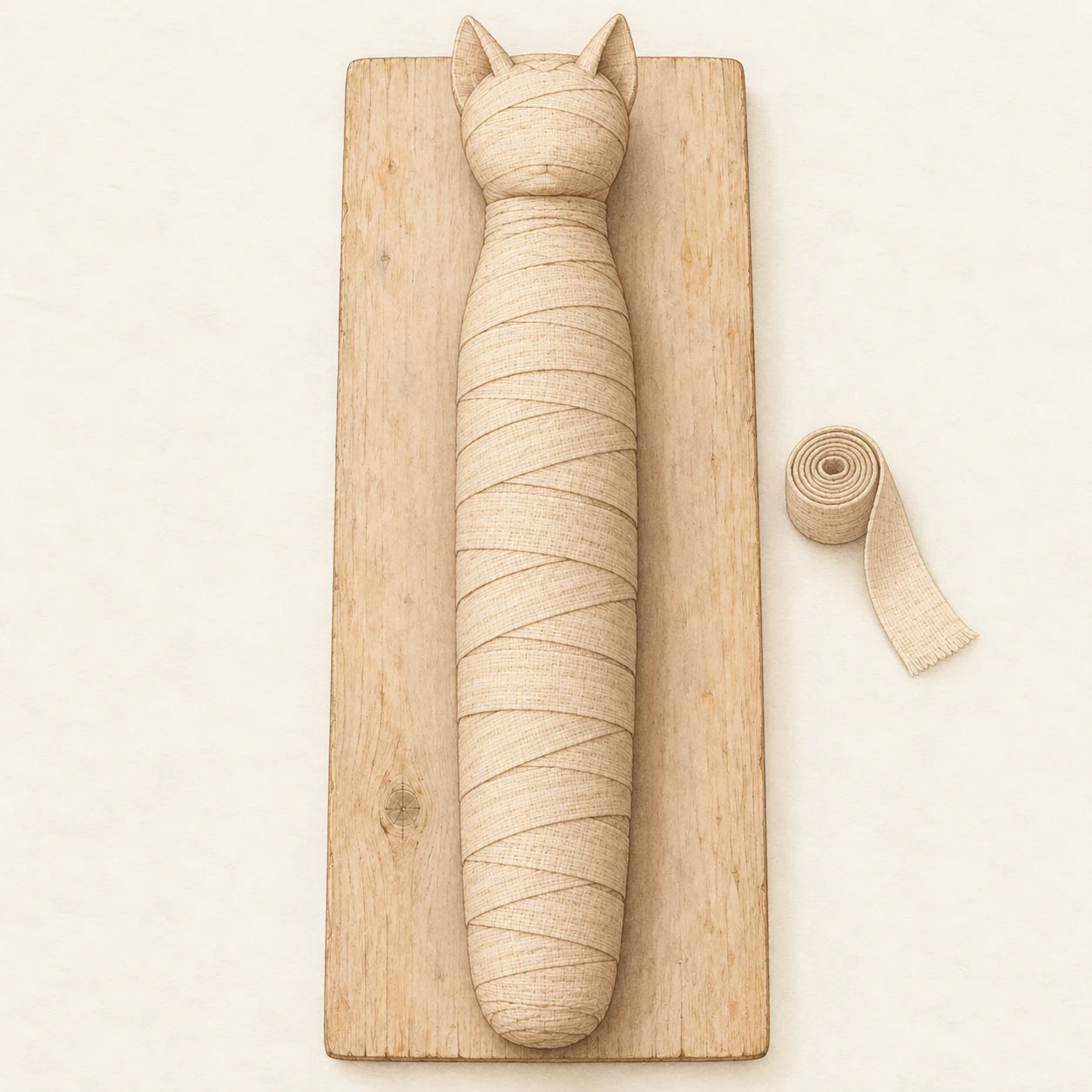
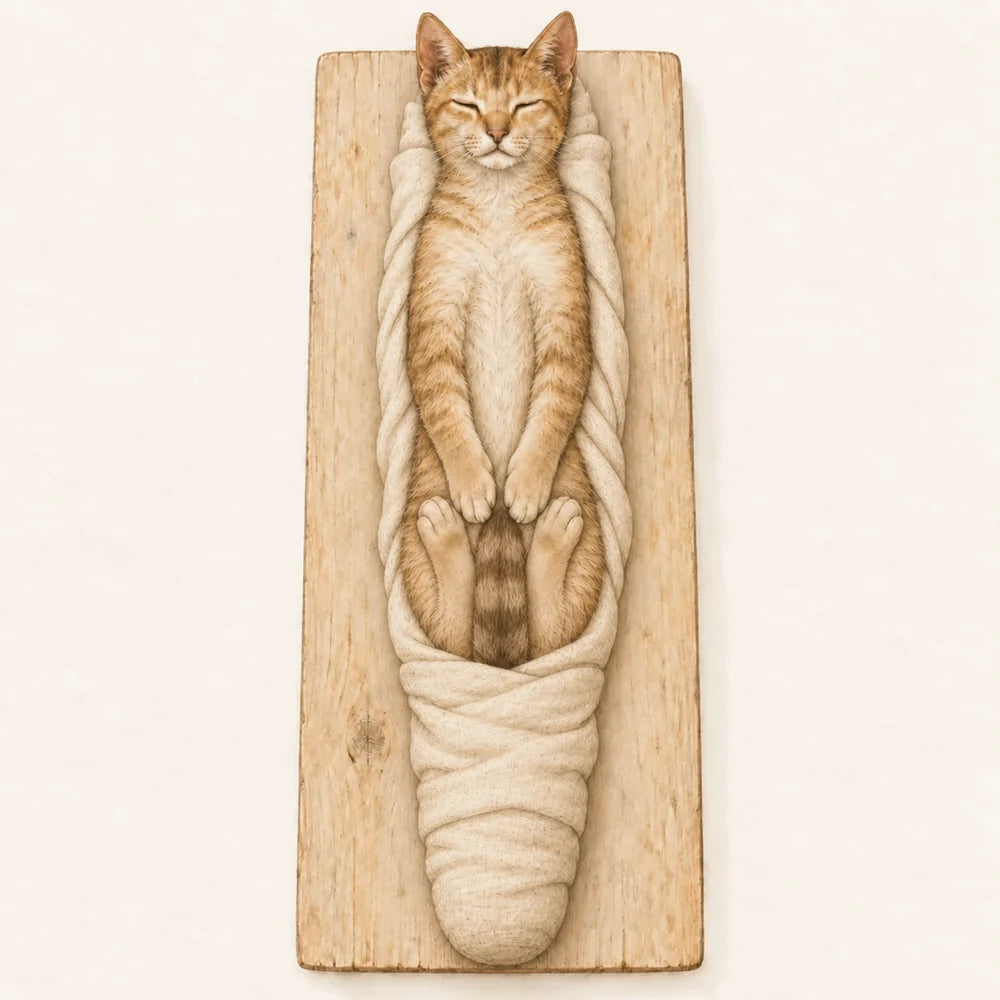
02 / Wrap
Lay the linen.
Choose linen; each layer reveals a little more about the cloth.
Choose linen; each layer reveals a little more about the cloth.
Linen is woven from flax, a plant grown in ancient Egypt for its useful fibres.
Flexible strips could follow the body’s shape; layers of cloth helped hold the bundle together.
Bandages and padding shaped some cat mummies into long bundles, with heads carefully modelled in linen.
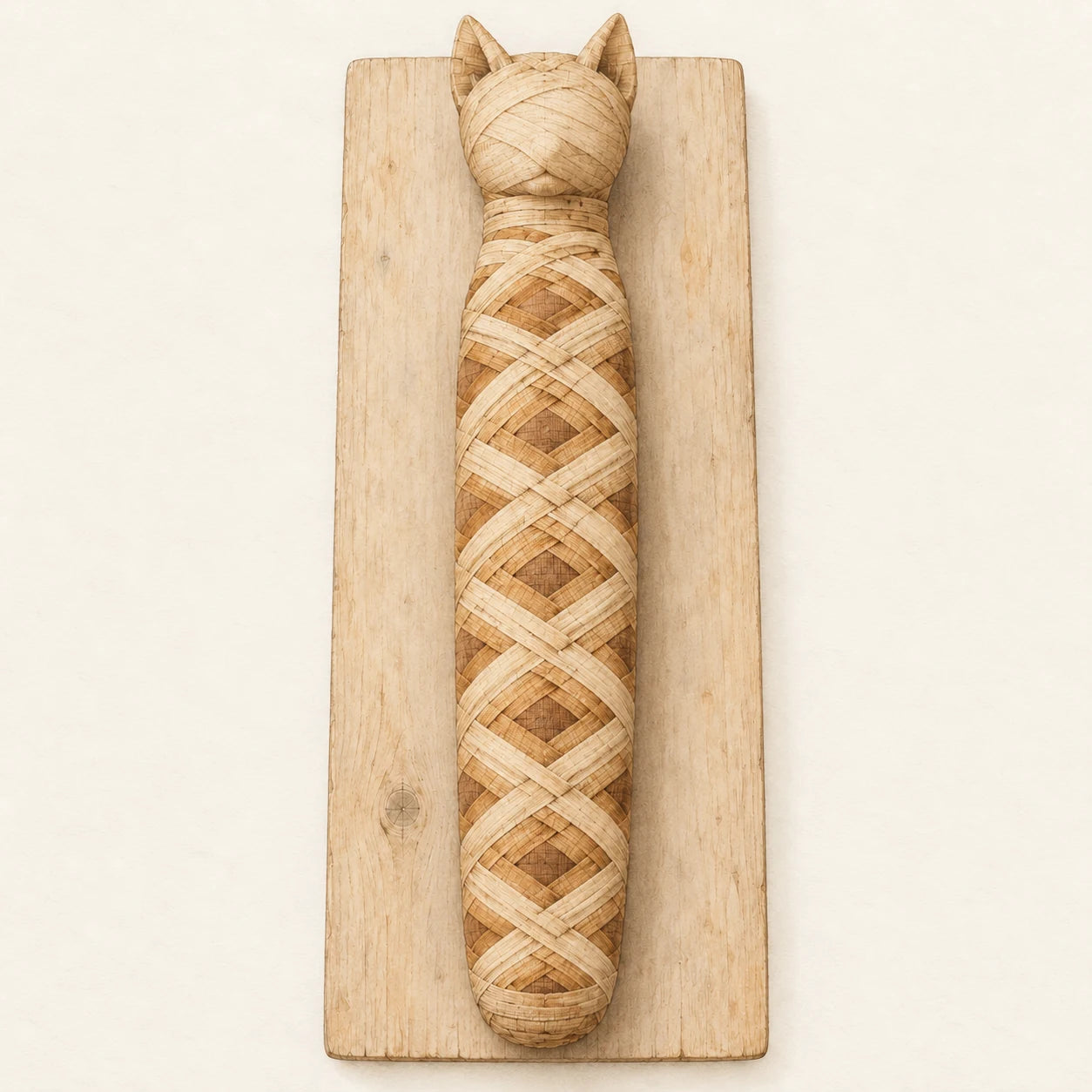
03 / Pattern
Fold a little geometry.
Cross the linen in three passes, working from feet to head.
Cross the linen in three passes, working from feet to head.
Wrapping was part of preparing a sacred offering, giving the preserved animal a carefully finished form.
Light and dark linen could be folded into diamonds or checkerboards, turning bandages into decoration.
Surviving cat mummies show many different designs. These crossing folds are inspired by their makers’ care.
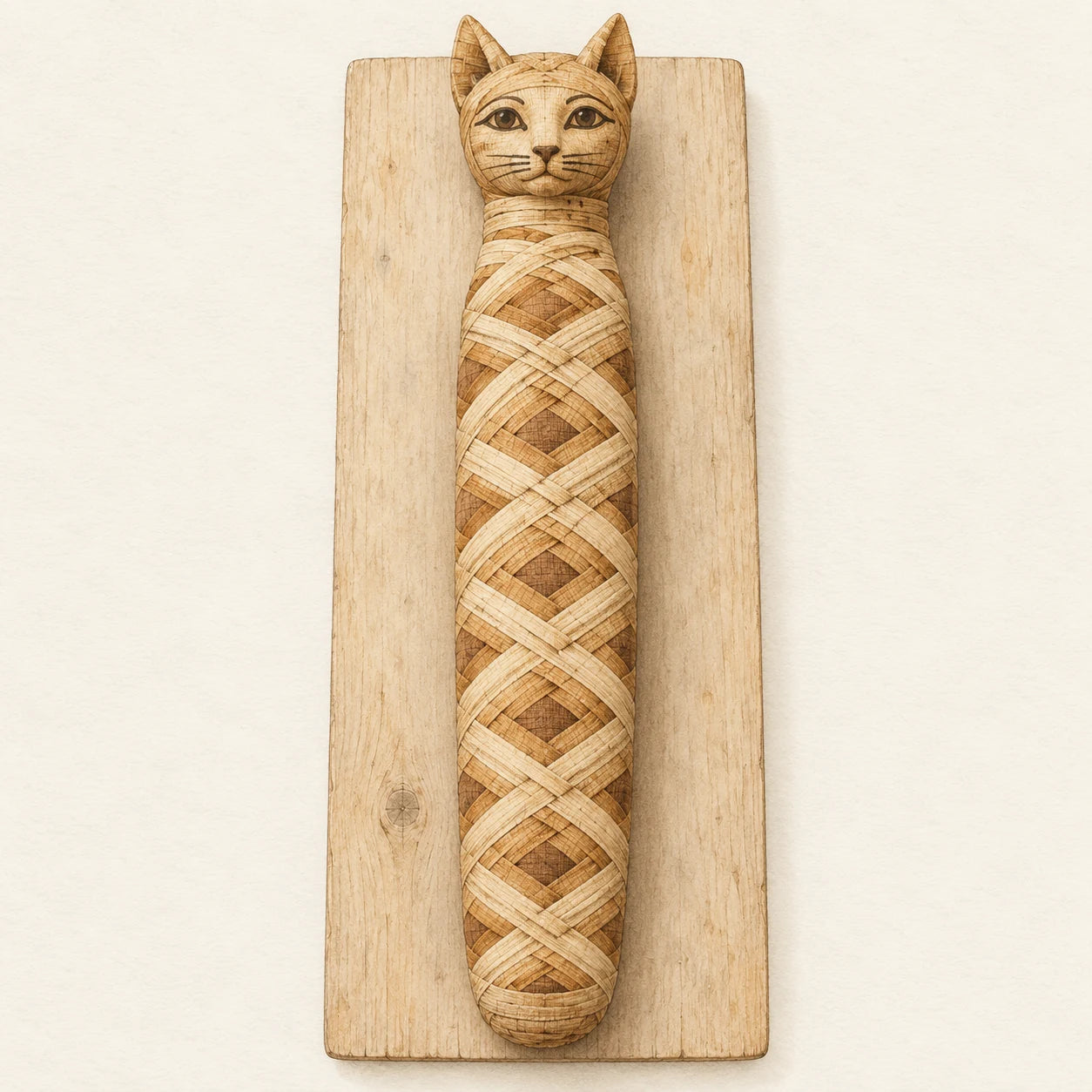
04 / Paint
Give the cat a face.
Brush in the eyes, nose, and whiskers.
Brush in the eyes, nose, and whiskers.
Brush in the eyes, bringing a feline gaze back to the linen.
Add the nose, a small detail that makes the face recognisable.
Finish the whiskers; painted features helped the bundle resemble a cat.
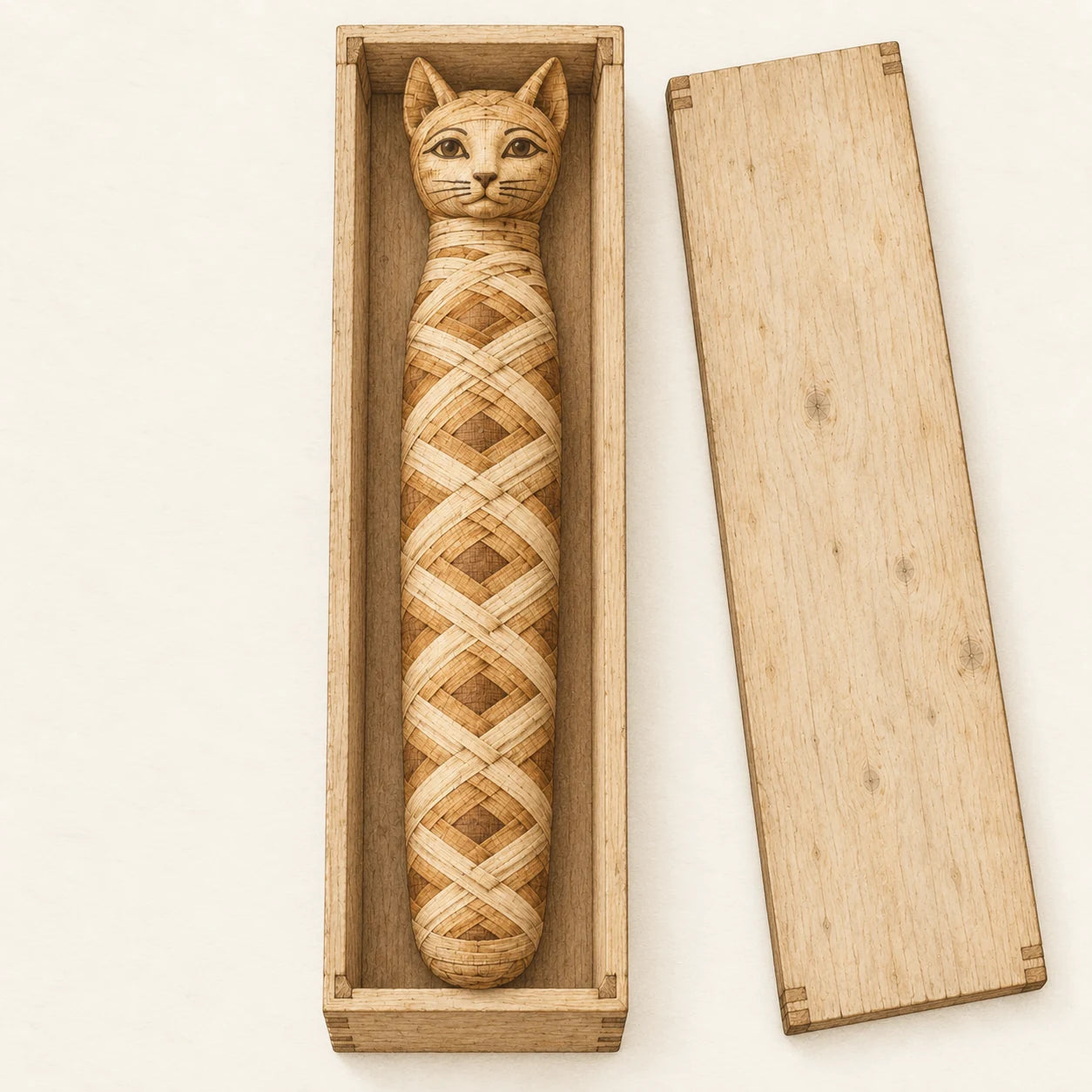
05 / Dedicate
An offering, ready.
Lower the finished bundle into its wooden box.
Lower the finished bundle into its wooden box.
A votive offering was a religious gift associated with a deity. Some cat mummies were placed in containers and dedicated to Bastet.
Five stages complete
Small folds. A lasting purpose.
A votive offering was a religious gift associated with a deity. Some cat mummies were placed in containers and dedicated to Bastet.
04 / The gaze that stays with us
Something familiar, across the centuries.
We began with a cat by a doorway. We have travelled to a festival city, looked at sacred gifts, and followed the folds in a length of linen.
Bastet brings those different worlds together. Her story has room for fierce protection and nurturing care, for solemn dedication and the sound of people enjoying themselves.
Today, you might choose a Bastet figure because you love cats, because Egyptian art speaks to you, or because its watchful pose feels right in your home. That personal meaning is yours to give. Learning the older story simply lets you meet the image with a little more understanding.
From our collection in Calgary
A little presence of her own.
Two contemporary interpretations of an ancient, watchful form. These photographs show pieces from our catalog.

Bastet Mini Statue ↗
Gold details catch the eye; upright ears carry that familiar sense of attention.

Bastet Seated on a Scarab ↗
A quiet silhouette with a richly detailed collar and a scarab beneath her paws.
A few things you might be wondering
Getting to know Bastet.
Is Bast the same as Bastet?
Yes. You will encounter both names in English-language writing about this goddess. “Bastet” is the form used throughout this article.
Did Egyptians think every cat was a god?
That is too simple a description. Cats could be companions, sacred animals, and representations connected with a deity. Bastet was the goddess; an individual cat’s religious role depended on its setting and the practices around it.
Were cat mummies made exactly like human mummies?
No single recipe covers them all. Materials, preparation, and the contents of bundles varied. Our activity introduces a few visible materials and techniques; it is a simplified illustration, not a reconstruction of every stage.
Can you visit Bubastis today?
The ancient city survives as the archaeological site of Tell Basta, near Zagazig in the eastern Nile Delta. Its surviving ruins are different from the busy festival city described by Herodotus. For the research behind the site, explore the Tell Basta Project.